This review hbada e3 pro looks at a mesh office chair built around extensive posture adjustments, from a pivoting three-zone lumbar system to a dual-axis headrest and highly configurable armrests.
Its broad fit range and recline options make it worth considering for home-office users who regularly change position at their desk.
Hbada E3 Pro Review Summary
The quick verdict
1,000+ ratings
Read Amazon ReviewsHbada E3 Pro
A mesh office chair for buyers who want adjustable lumbar, head, and arm support, plus a wide range of recline positions.
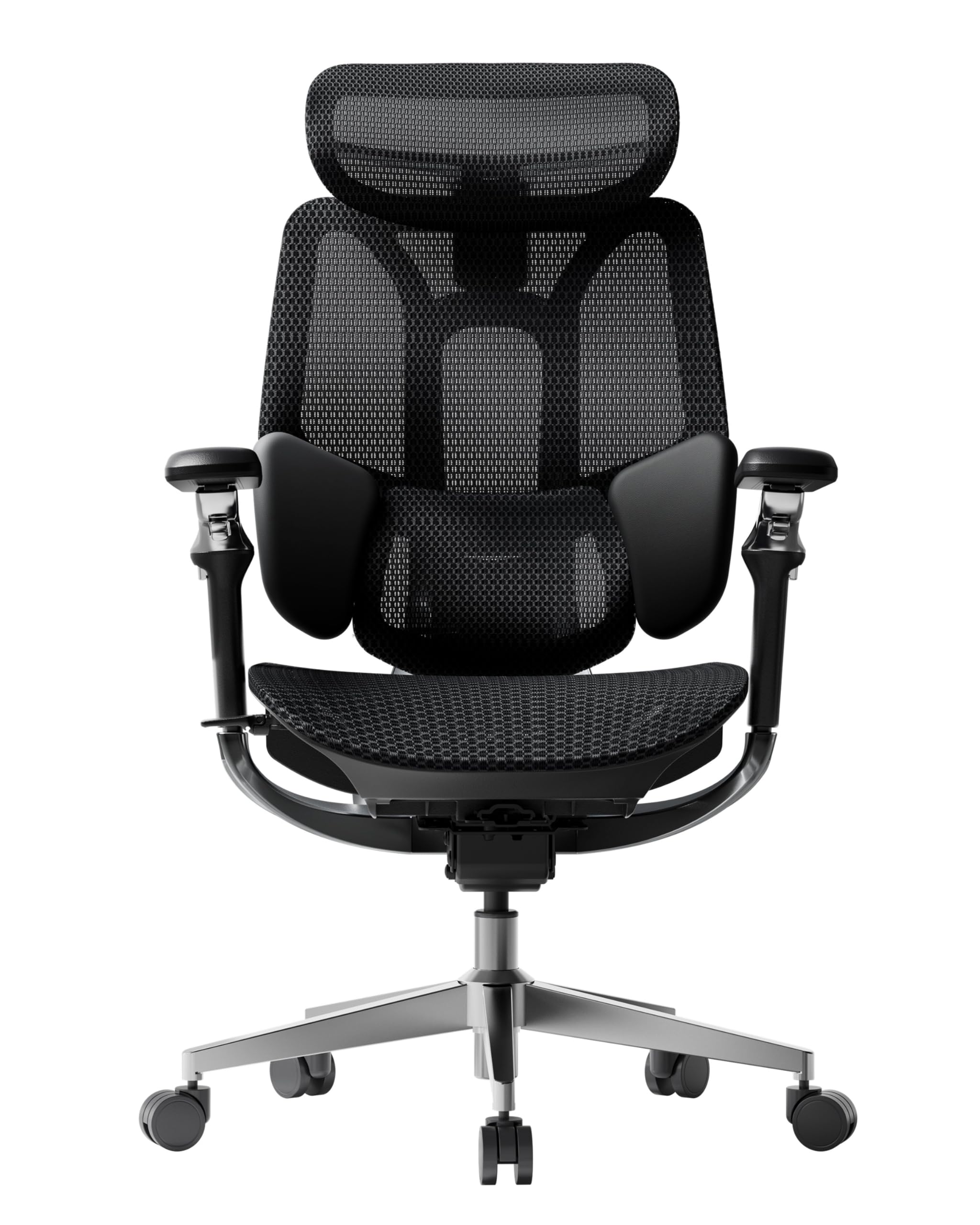
- Three-zone floating lumbar support has pivoting side wings with a described 40-to-80-degree range and 60 mm of vertical adjustment.
- The dual-axis headrest adjusts 70 mm in depth, 40 mm in height, and rotates through 70 degrees.
- The chair reclines to four described positions: 105, 115, 130, and up to 140 degrees; the gravity-sensing tilt mechanism adjusts tension based on body weight.
- The mesh seat and back use high-elasticity material designed for flexible support and airflow.

Pros
- Extensive lumbar adjustment gives users more control over where the support meets the lower back.
- The headrest has separate height, depth, and rotation adjustments for a more tailored neck position.
Consider before buying
- The many adjustment points may take time to set up and fine-tune; buyers who prefer a straightforward chair may find the feature set more involved than they need.
- The stated weight recommendation is 300 pounds, so buyers who need a higher capacity should check other models.
Read the full review summary
The Hbada E3 Pro puts adjustability at the center of its design. Its lumbar support moves vertically and pivots at the sides, the backrest height and seat depth adjust, and the headrest offers height, depth, and rotation settings.
Those features give buyers several ways to tune how the chair meets their back, neck, and legs rather than relying on a single fixed posture.
It is aimed at adults between 5 feet 1 inch and 6 feet 5 inches, with a stated maximum weight recommendation of 300 pounds.
The mesh seat and back, multiple recline angles, and weight-sensing tilt may suit people who alternate between focused work and breaks.
The tradeoff is that this is a feature-dense chair: buyers who want a simple seat with only basic adjustments may not need its range of moving parts.
The buying factors
Hbada E3 Pro Scorecard
Editorial scores reflect listed features and buyer fit; they are not laboratory measurements or customer ratings.
Lumbar adjustability
The three-zone support pivots at the sides and adjusts vertically by 60 mm, giving buyers more ways to position it against the lower back.
Head and neck support
The dual-axis headrest adjusts in height, depth, and rotation, providing a broad range for finding a comfortable alignment.
Armrest flexibility
Dual 360-degree rotation and 39-degree folding let the armrests accommodate varied elbow positions and desk approaches.
Recline range
Four described positions extend up to 140 degrees, covering upright work and more relaxed sitting.
Fit range
The stated height range is broad, and backrest height, lumbar position, and seat depth all adjust.
Materials and airflow
The elastic mesh design is intended to provide flexible support and airflow across the chair's contact surfaces.
Key Features and Specifications of Hbada E3 Pro
- Three-zone floating lumbar support has pivoting side wings with a described 40-to-80-degree range and 60 mm of vertical adjustment.
- The dual-axis headrest adjusts 70 mm in depth, 40 mm in height, and rotates through 70 degrees.
- The chair reclines to four described positions: 105, 115, 130, and up to 140 degrees; the gravity-sensing tilt mechanism adjusts tension based on body weight.
- The mesh seat and back use high-elasticity material designed for flexible support and airflow.
- The armrests combine two 360-degree rotations with 39-degree folding for a wide range of elbow positions.
- Fit adjustments include 80 mm of backrest height, 60 mm of lumbar height, and 50 mm of seat depth; the recommended user height range is 5 feet 1 inch to 6 feet 5 inches.
- The chair has a stated 300-pound maximum weight recommendation, an SGS-certified Class 4 gas cylinder, and BIFMA compliance.
Pros and Cons of Hbada E3 Pro
Pros
- Extensive lumbar adjustment gives users more control over where the support meets the lower back.
- The headrest has separate height, depth, and rotation adjustments for a more tailored neck position.
- Four recline positions support transitions between upright work and relaxed sitting.
- Seat depth and backrest height adjustments help accommodate different proportions within the stated height range.
- Mesh construction is designed to promote airflow while flexing with the sitter.
Consider before buying
- The many adjustment points may take time to set up and fine-tune; buyers who prefer a straightforward chair may find the feature set more involved than they need.
- The stated weight recommendation is 300 pounds, so buyers who need a higher capacity should check other models.
- Before buying, compare the listed 50 mm seat-depth adjustment and overall chair dimensions with your desk and leg-length needs, since a stated user-height range cannot guarantee an individual fit.
Who Should Buy Hbada E3 Pro?
Good fit
Consider the Hbada E3 Pro if you want a mesh office chair with several independent ways to tune back, neck, and arm support.
The pivoting lumbar wings and vertical adjustment stand out for buyers who have struggled to position a fixed support pad comfortably. The adjustable backrest and seat depth add further options for matching the chair to your posture.
It also makes sense if you regularly move between upright desk work and leaning back.
Its listed recline positions reach up to 140 degrees, and the gravity-sensing mechanism is designed to adjust tilt tension in response to body weight.
Check the dimensions and adjustment ranges against your desk setup, then confirm that the chair’s 300-pound recommendation fits your needs.
Who should skip it
Look elsewhere if you want a chair with a higher stated weight capacity, or if you prefer a minimal design with fewer settings to manage.
This model’s appeal depends on having a reason to use its many adjustment options.
Hbada E3 Pro Review: How Its Adjustments Shape the Fit
Lumbar movement for changing posture
The lumbar system combines pivoting side wings with 60 mm of vertical travel. That design gives users more control over both the support position and how closely the sides wrap around the back.
It may be useful for people who shift between leaning forward and reclining, though the best fit will depend on where the support lands on each person’s lower back.
A headrest with several alignment controls
The headrest’s height, depth, and rotation adjustments let users change where it meets the head and neck.
This is most relevant during calls or reclined breaks, when a fixed headrest may not line up the same way as it does during upright typing.
The listed adjustment ranges make it possible to experiment with its position rather than accepting one preset.
Recline for work and breaks
The four described angles span upright work through a more reclined position of up to 140 degrees. Paired with a tilt system that responds to body weight, this setup is intended to make changing posture easier.
Buyers should still consider how often they recline and whether they prefer a chair that locks into set positions or one that moves with them.
A fit checklist before ordering
The E3 Pro lists a user-height range of 5 feet 1 inch to 6 feet 5 inches, plus backrest, lumbar, and seat-depth adjustment.
Use the stated 50 mm seat-depth range and 27.5-inch width and depth dimensions as a starting point for checking your workspace.
If you can, compare the seat and desk heights with your usual posture before deciding; a broad height range is a guide, not a guarantee of individual comfort.
Alternatives to Hbada E3 Pro
Home Office Desk Chairs alternative
17,000+ ratings
Read Amazon ReviewsSIHOO M57
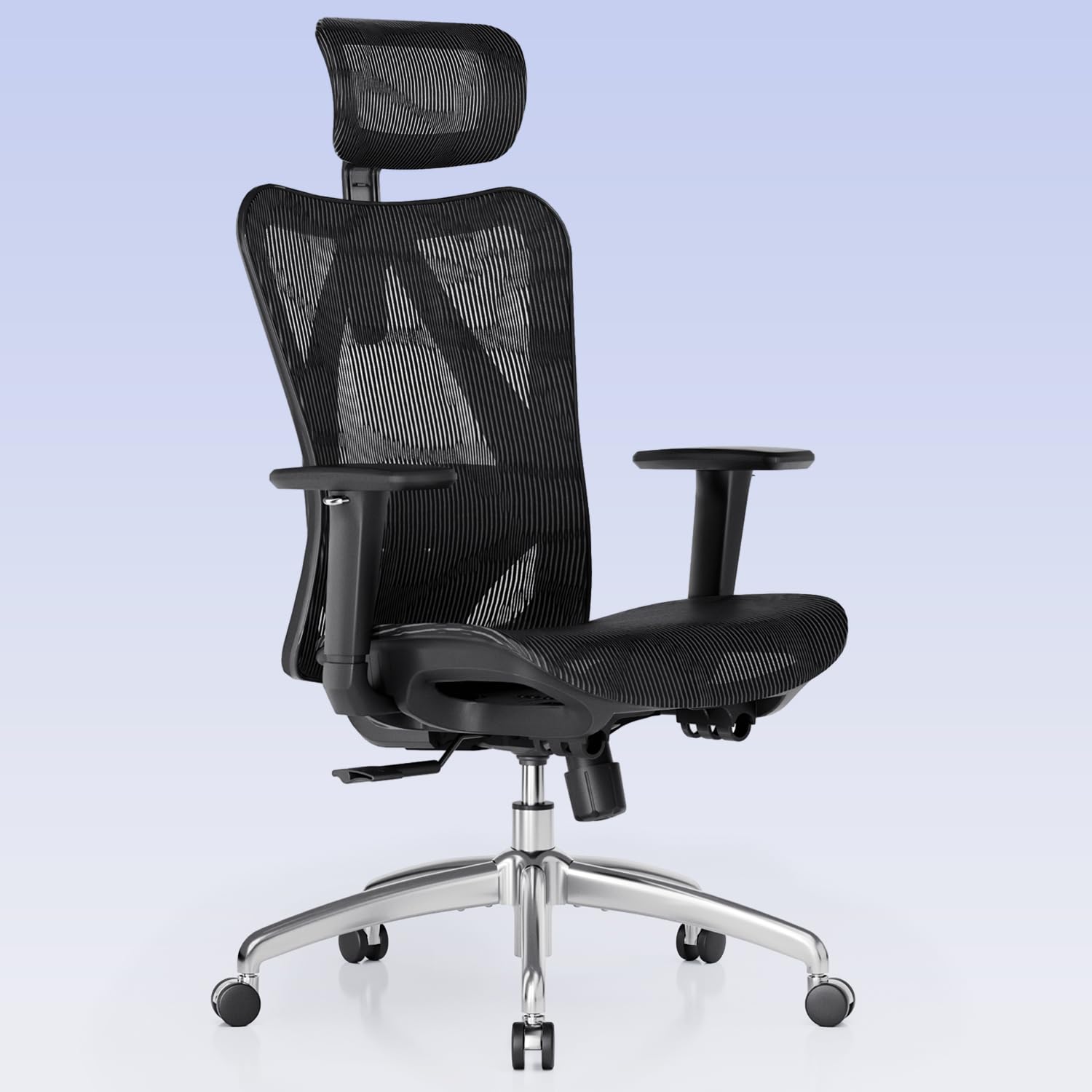
Consider the M57 if its waterfall-edge seat and stated higher weight capacity better match your priorities. The E3 Pro may suit you more if you want the listed broader recline range and more articulated headrest and armrest adjustments.
- The SIHOO M57 describes lumbar support adjustable in height and depth, a tilting and lifting headrest, recline from 90 to 126 degrees, a split backrest, and a waterfall-edge seat.
- It has a stated 330-pound capacity.
- The Hbada E3 Pro offers pivoting three-zone lumbar support, a headrest with depth, height, and rotation adjustments, and recline up to 140 degrees.
Home Office Desk Chairs alternative
17,000+ ratings
Read Amazon ReviewsSIHOO B100 Pro
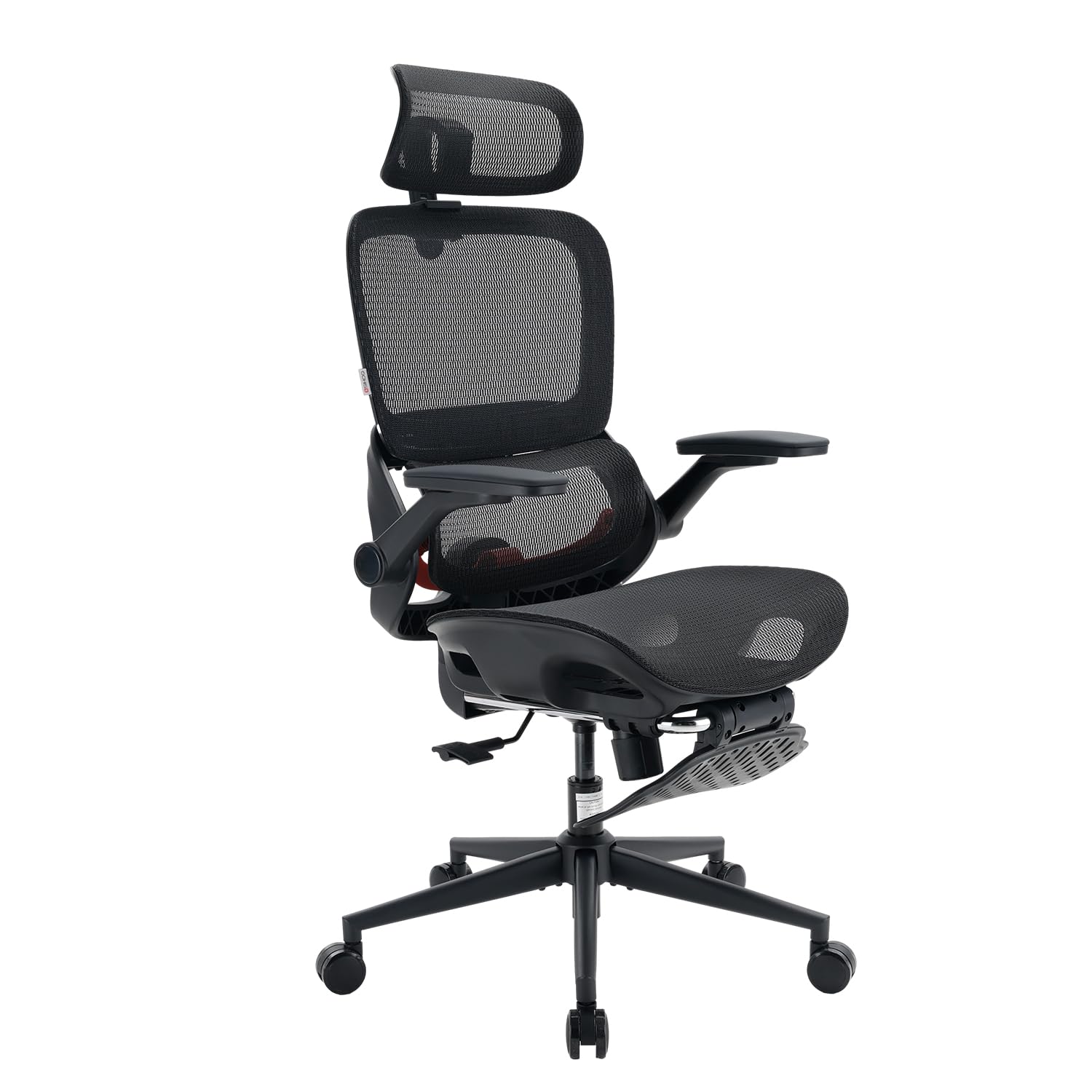
Choose the B100 Pro if a retractable footrest and a wider cushioned seat are more useful to you for breaks.
The E3 Pro is a better fit to investigate if you prioritize its described lumbar-wing movement, headrest adjustment, and higher maximum recline angle.
- The SIHOO B100 Pro adds a retractable footrest, a widened cushioned seat, a 3D wide headrest, and three recline angles up to 135 degrees.
- Its mesh seat and back are designed for airflow, and it has a stated 300-pound capacity.
- The Hbada E3 Pro emphasizes adjustable lumbar wings, a multi-axis headrest, mesh construction, and recline positions up to 140 degrees.
Is Hbada E3 Pro Worth It?
The Hbada E3 Pro is worth considering if you want an adjustable mesh chair with detailed lumbar positioning, a configurable headrest, flexible armrests, and several recline settings.
Its combination of adjustments is best suited to buyers willing to spend time finding a personal fit.
Before choosing it, check your desk dimensions, the 50 mm seat-depth travel, and the 300-pound weight recommendation against your needs.
If those line up and you expect to use the adjustment range, the E3 Pro presents a strong feature set for varied desk postures.
Your review at a glance
1,000+ ratings
Read Amazon ReviewsHbada E3 Pro
A mesh office chair for buyers who want adjustable lumbar, head, and arm support, plus a wide range of recline positions.
- Three-zone floating lumbar support has pivoting side wings with a described 40-to-80-degree range and 60 mm of vertical adjustment.
- The dual-axis headrest adjusts 70 mm in depth, 40 mm in height, and rotates through 70 degrees.
- The chair reclines to four described positions: 105, 115, 130, and up to 140 degrees; the gravity-sensing tilt mechanism adjusts tension based on body weight.
- The mesh seat and back use high-elasticity material designed for flexible support and airflow.